The alarm was set at “early” because we wanted to make as much ground as possible before the thunderstorms forecasted for Sunday. We had heard thunder all night and it was very wet, so we made the executive decision to take a rest day – our first on tour. The weather at least here in Custer turned out much nicer than feared, so a few regrets that we did not go. On the other hand a rest day has done us good. Troels is suffering from saddle soars and one day off the saddle could be beneficial but as an extra bonus there was an outdoor shop here in town, where he could by himself an extra saddle. Please notice on the pictures the coming the days that the saddle more looks like something from a grandma’s bicycle.
Crazy Horse Monument
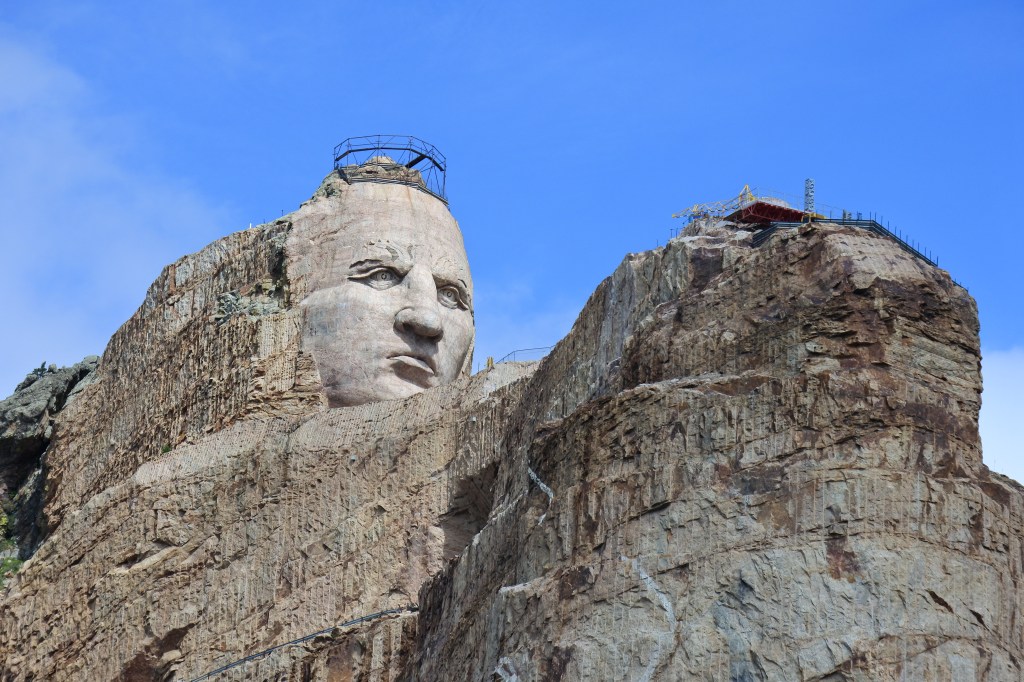
As the top tuned Tour de France heroes, I would not let my body rest fully. so I took the cycle up the hill to Crazy Horse Monument. I wrote some uneducated babble about Crazy Horse yesterday but after 2½ hours at the monument, the movie theater and the exhibition, I feel so clever that I can tell the story in short. I am aware that US readers know all from school but I am sure that I have a few readers who will hear this for the first time. And it is the highlight of the day, so bear with me.
In order to tell the story, I have to introduce three characters:
Crazy Horse was never photographed, which I will come to later, and when people asked him if they could take a photo he would answer “whether he would also let people trap has shadow”. He was born around where we are now in the mid 19th century and was the war leader who headed the battle against General Custer at the famous Little Big Horn or “Custer’s last Stand”. The background for the war was the natural conflict between Native Americans who considered the land sacred and nobody’s at least no individual body’s againts the White American who built a society on ownership and rights to land.
According to a treaty between the White and the Red Americans the Native Americans were given the Black Hills, which we have just been through, but when gold was found the land became somewhat more interesting to the white man and subsequently the Native Americans defended their land in the battle against General Custer who was defeated. Crazy Horse died in 1877 (with details around his death enough to fill several paragraphs on Wikipedia, but now you know Crazy Horse).
There are pictures of another Native American, however, Henry Standing Bear. He was a Chief born in 1874 and lived until 1953. A new generation of a chief as he was portrayed in an introductory movie at the museum. He understood that to preserve Native American culture, education and dialogue was the way to go. He studied rethorics and worked in a mundane organization as Sears Roebuck in Chicago.

Finally we have Korczak Ziolkowsky. He worked as an assistant on the Mt. Rushmore project but was fired.
While the Mt. Rushmore project took place Henry Standing Bear took contact to Korczak because he wanted to make the point that the red people has also had great leaders as the white people had had Washington, Lincoln, Jefferson and Roosevelt.
So in 1948 Korczak built a house for his wife Ruth and their 10 children, five boys and five girls and started to remove massive amounts of rock from a mountain by dynamite and carve in what was left. At the site you can now see Crazy Horse’s head but there is still a lot of work left before we see his horse and the rest of Crazy Horse. Right now 14 full time workers are working on a hand and a finger, so my prediction is that nobody who lives today will see the final monument. The project is not publicly funded, so visitors like me (7 dollars for a bicycle entry and 4 dollars for a tour on the bus) are paying for the progress. Luckily there are more visitors than a lonely biker from Denmark. The bus driver Cass told that there are more than 1 million visitors a year, and I can testify that not many people come on bicycles, so most other vehicles contribute a little more. He also told that the most asked question is: “When will you be finished?” and the answer is that nobody knows.

There is a plan for the next steps but funds will decide how things will advance. Then I asked whether a load of money would speed up the completion and I got the answer that it would probably not.
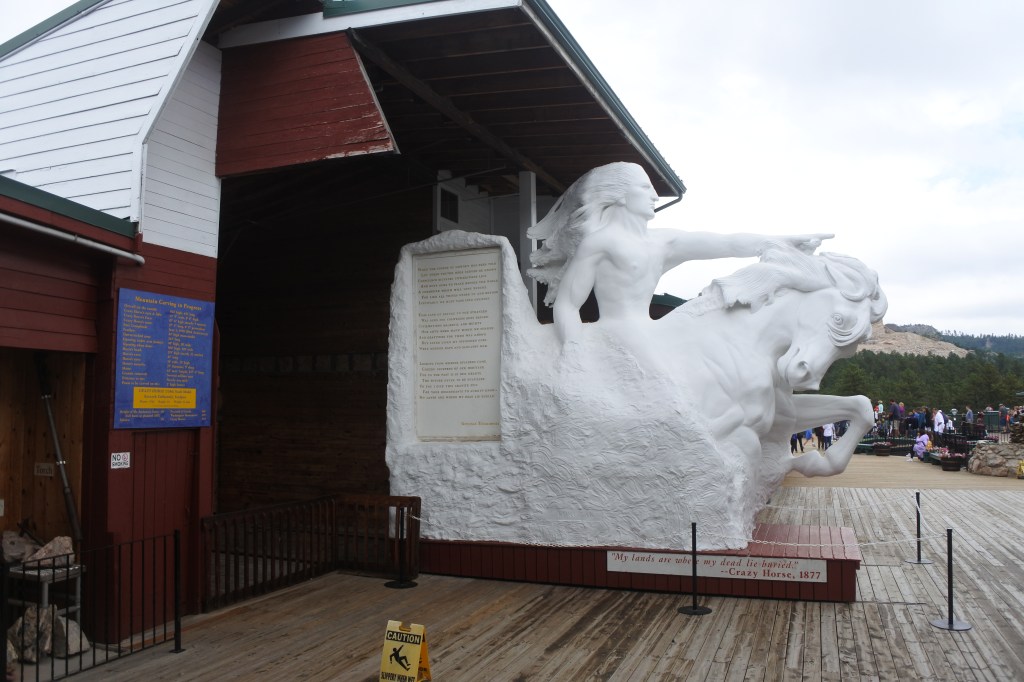
The carving has become a living organism and in order not to make mistakes (where the head of the horse suddenly drops off for instance) carving has to happen at a certain pace. He further told that the 14 carving staff work year round. They abandon work when the temperature falls below 0 (which must be Fahrenheit and eq. to app. minus 18-20 Celsius) and when lightning hit the is observed in a 30 mile radius. Cass said that there is often more work lost in summer, because lightning is more prevalent than sub zero degrees. Which circles around to our reason for a rest day: Threat of thunder. We want to cover more than 100 miles tomorrow and the Monday forecast looks promising.
A (great) rest day
We had got very focused on making mileage and advancing at a high pace but a combination of things “forced” upon us to take a rest day. That has been nice. We are still good buddies but getting to spend a little time apart and bring back experiences to share at dinner has been good. And if we had not rested, I would have taken a photo of Crazy Horse at one mile’s distance and moved on. My next bike trip will probably build in a few forced rest days.
Crazy Horse never photographed
I promised to come back on the fact that there are no photos of Crazy Horse. How on earth do you then spend 70 years to carve his face in a mountain if it is even not his face?
At the museum there was a picture of some old warriors who had fought at the battle at Little Big Horn. It was taken in 1948. Supposedly Korczak had been with this warriors and had interviewed them about his features.
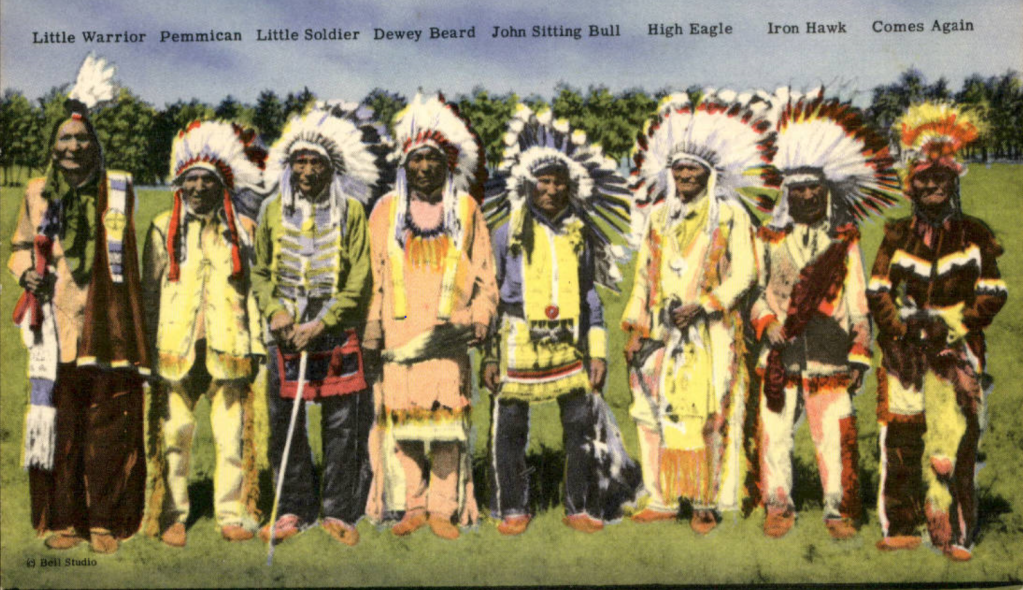
Furthermore a Mormon missionary who could draw, drew a picture for Crazy Horse’s sister on her own description and she told that the image was a fair reproduction of Crazy Horse.
Finally the fun fact, that when Korczak died in 1982 there was no face and no horse yet on the monument, and though Korczat was in favor of carving the horse first his family decided after his death that the face or the head should be completed first. Other visitors I spoke to confirmed that it was the right decision as the face of Crazy Horse probably would attract more visitors, to that the could complete Mt Rushmore with the carving of a fifth great American leader than would a horse.
Many people study European History because it goes back a long time, but I enjoy the roughness and the “newness” of American history. 1982 when Korczak died was in my lifetime. Korczak meeting Henry Standing Bear in 1948 is only 14 yerars before my birth and being contemporay with warriors who fought at Little Big Horn. It could also mean that I am getting older but I prefer to think of the fact that so much has happened within a two centuries.

 popscycletour.com